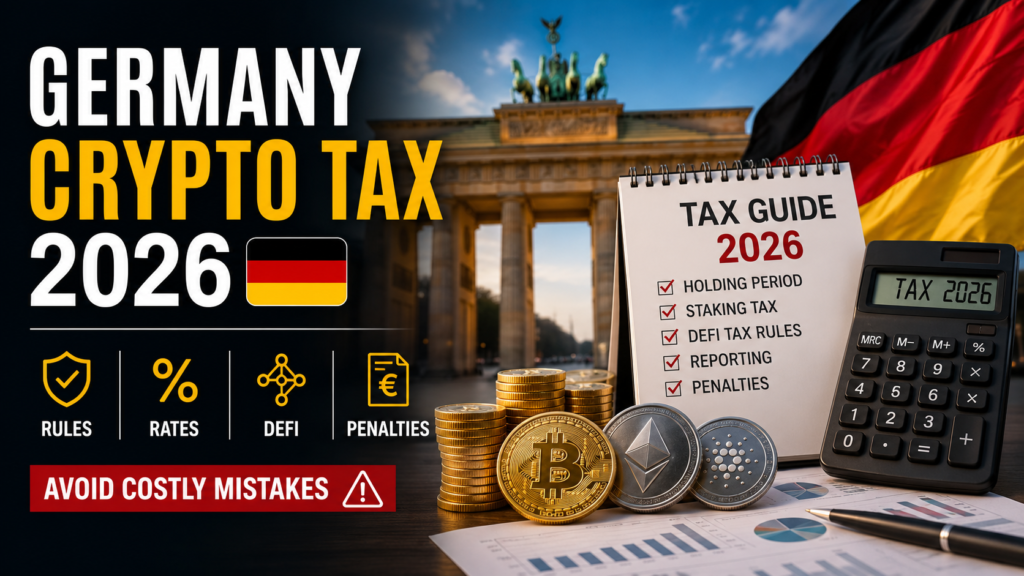
Crypto tax Germany 2026 is one of the most investor-friendly in the world — hold Bitcoin for just 12 months and pay zero tax on your profits. This guide breaks down crypto tax rules in Germany, France and across the EU in plain language. — or visit our crypto glossary for key terms explained simply.
Disclaimer: This content is for educational purposes only and does not constitute financial, legal, or tax advice. Crypto tax laws vary by country and change frequently. Always consult a qualified tax professional or legal advisor for your specific situation. Cryptocurrency is highly volatile — only invest what you can afford to lose.
Topic 1: Crypto Tax in Germany Explained (2026)
Crypto tax Germany 2026 makes this one of the most crypto-friendly countries in the Western world. And honestly? The tax system here rewards patience. Hold your Bitcoin for just over a year — and you owe the
government exactly nothing on your profits. That’s not a loophole. That’s the law. Let’s break it all down.
Is Crypto Legal in Germany?
Yes, completely. The German government recognizes crypto as a digital representation of value — a form
of private money. Individuals and businesses can buy, hold, and trade freely. Businesses dealing with
crypto must register with BaFin, Germany’s financial regulator, but for private investors, there’s no license
needed.
Crypto Tax Germany 2026 — The 0% Rule Explained
This is the big one for crypto tax Germany 2026. Under German tax law, crypto is classified as a ‘private asset’ (Privatvermogen). If you sell crypto you’ve held for more than 12 months, your capital gains are completely tax-free — no matter how large the profit.
Example:
You bought 1 BTC in January 2025 for €40,000. You sell it in February 2026 for €80,000. Your €40,000 profit is 100% tax-free because you held for over a year
What If You Sell Within 12 Months?
If you sell before the 12-month mark, your gain is added to your regular income and taxed at your personal
income tax rate — which ranges from 14% to 45%, plus a 5.5% solidarity surcharge on top.
Taxable Income | Tax Rate |
Up to €12,348 | 0% (personal allowance) |
€12,349 – €62,809 | 14% – 42% |
Above €277,826 | 45% (top rate) |
Solidarity surcharge | 5.5% on the calculated tax |
Annual Tax-Free Allowances
- €1,000 per year — short-term gains below this amount are tax-free
- €256 per year — income from staking, lending, or mining below this is tax-free
- €12,348 — personal income allowance (no tax below this total income)
- Crypto gifts to a spouse — tax-free up to €500,000
What Counts as a Taxable Event?
- Selling crypto for euros (within 12 months)
- Swapping one crypto for another — e.g. BTC to ETH — this counts as two disposals
- Spending crypto on goods or services
- Mining or staking rewards — taxed as income at the time you receive them
What Is NOT Taxable?
- Simply buying and holding crypto
- Transferring crypto between your own wallets
- Selling crypto you’ve held for over 12 months
Important 2026 Update: DAC8
Starting January 2026, the EU’s DAC8 directive requires all crypto exchanges operating in the EU to
automatically report user transaction data to Germany’s Federal Central Tax Office (BZSt). The days of
hidden crypto gains are officially over. Keep accurate records.
When to File
Your annual tax return for the 2025 financial year is due by 31 July 2026. Germany uses the FIFO (First
In, First Out) method for calculating gains — the first crypto you bought is treated as the first you sold.
Pro Tip:
The simplest legal strategy for crypto tax Germany 2026: just hold. If you can wait 12 months, you owe zero tax on your profits. It’s the most powerful tax tool available to German crypto investors.
Topic 2: Is Crypto Legal in France? (2026 Guide)
Short answer: Yes. Buying, holding, and trading crypto is perfectly legal in France. The French
government was actually one of the first in Europe to build a formal legal framework for crypto — back in
2019 with the PACTE Act. But legal doesn’t mean tax-free. France has some of the more specific rules in
Europe, so let’s walk through what you need to know.
Is Crypto Legal in France?
Absolutely. France doesn’t ban or restrict individuals from owning crypto. However, the government does
not consider crypto to be legal tender — it classifies it as a ‘digital asset’ (actif numerique). Exchanges and
platforms that offer crypto services must register with the AMF (Autorité des Marchés Financiers) as
Crypto-Asset Service Providers (CASPs) under the EU’s MiCA regulation.
The Key Tax Rule: You Only Pay When You Exit to Euros
Here’s the most important rule in French crypto tax law, and it’s actually quite investor-friendly: you only
owe tax when you convert crypto into euros or use it to buy goods and services.
- Swapping Bitcoin for Ethereum — NOT taxable
- Swapping Bitcoin for a stablecoin like USDC — NOT taxable
- Selling Bitcoin for euros — TAXABLE
- Using ETH to buy a laptop — TAXABLE
- Simply holding crypto — NOT taxable
The Tax Rate: 31.4% Flat (2026)
For occasional investors, France applies the PFU (Prélevement Forfaitaire Unique) — a flat tax. As of
2026, the rate has increased slightly to 31.4%, made up of 12.8% income tax plus 18.6% in social
contributions. This increase was triggered by the Social Security Financing Act (PLFSS 2026), which
added 1.4% to fund elderly care.
Optional:
You can opt out of the flat rate and use France’s progressive income tax instead. This can
be cheaper if you’re in a low tax bracket — but social charges of 18.6% always apply regardless.
Occasional vs Professional Investor
Your tax rate depends on whether the DGFiP (French tax authority) considers you an occasional or
professional trader. Professional traders face progressive income tax rates up to 45% plus social charges
— potentially reaching 63.6% at the very top.
- Occasional investor — buys and holds, trades infrequently: 31.4% flat tax
- Professional trader — frequent trading, treated like a business: 0–45% progressive + 18.6% social
- Miners & stakers — income taxed under BNC (non-commercial profits) at time of receipt
Annual Tax-Free Threshold
If your total crypto sale proceeds for the year are below €305, you owe no capital gains tax. But watch out
— this threshold applies to total proceeds, not just your profit. And even below €305, you still need to
declare your foreign crypto accounts.
2026 Changes: DAC8 & Stricter Reporting
Starting 2026, France participates in both DAC8 and CARF — international frameworks that force crypto
exchanges to automatically share your transaction data with the DGFiP. Platforms like Binance, Kraken,
and Coinbase now report your trades directly to the French tax authority. Self-reporting is no longer
optional — it’s inevitable
Forms You’ll Need
- Form 2042 C — declare overall capital gain or loss
- Form 2086 — detailed breakdown of each crypto disposal
- Form 3916-bis — declare every foreign crypto account (one form per exchange)
Pro Tip:
The smartest legal move in France: rebalance your portfolio by swapping between cryptos
— not converting to euros. This way, you can restructure your holdings without triggering a taxable
event. Only sell to fiat when you actually need the cash.
Topic 3: Best Crypto Exchanges in Europe (2026)
If you’re trading crypto in Europe in 2026, the rules of the game have changed. Thanks to MiCA — the
EU’s landmark crypto regulation — you now have a clear way to check whether an exchange is legitimate:
look for their CASP (Crypto-Asset Service Provider) licence. Any exchange without one should be a hard
no. Here are the best of the regulated bunch.
What to Look for in a European Exchange (2026)
- MiCA CASP authorisation — check ESMA’s public register before depositing
- SEPA support — for cheap, fast EUR deposits and withdrawals
- Low fees — both trading fees AND spreads matter
- Proof of reserves — confirms the exchange actually holds your assets
- Customer support — you want humans, not just bots
Kraken — Best Overall for European Traders
Kraken has been operating since 2011 and is one of the most trusted names in European crypto. It
introduced the first BTC/EUR trading pair back in 2013 and remains the most liquid venue for
euro-denominated crypto trading on the continent. It’s fully MiCA compliant, never lost customer funds to a
hack in over a decade, and supports 450+ cryptocurrencies with SEPA deposits available for free. Fees
start at 0.26% for standard trades and drop further on Kraken Pro.
Best for: Long-term investors and traders who prioritise security and EUR liquidity.
Coinbase — Best for Beginners
Coinbase holds MiCA licences across Europe including in Germany, Netherlands, Ireland, and Italy. It’s
the most beginner-friendly option — the interface is clean, fees are shown before you confirm, and they
keep 98% of assets in cold storage. One thing to note: standard fees are on the higher side at around
1.49%, so intermediate users should switch to Coinbase Advanced for lower rates.
Best for: First-time buyers and casual investors across the EU.
OKX — Best for Advanced Traders
OKX secured full MiCA CASP authorisation through Malta’s MFSA and added a Payment Institution
licence in February 2026, making it one of the most comprehensively licensed exchanges in Europe. Fees
are among the lowest at 0.08% maker / 0.10% taker, and its Web3 wallet covers 130+ blockchains. The
catch: the interface is complex, and it’s not yet available in New York or all EU states.
Best for: Experienced DeFi users, derivatives traders, and low-fee seekers
Bitvavo — Best for Benelux Residents
Bitvavo is the dominant EUR spot exchange in Europe, reportedly holding around 50% of European EUR
spot trading volume. It’s licensed by the Dutch AFM, serves 2 million users with 350+ cryptocurrencies,
and offers a one-click interface that feels more like a banking app than a trading platform. Automatic
staking is available — no need to lock up your assets.
Best for: Dutch, Belgian, and German investors who want simplicity and excellent EUR liquidity.
Bitpanda — Best All-in-One European Platform
Based in Vienna and fully MiCA compliant, Bitpanda lets you manage crypto, stocks, and precious metals
all in one place. Its standout feature is Crypto Indices — you can buy a basket of the top 5, 10, or 25 coins
that automatically rebalances monthly. Fees sit at around 1.49%, but holding their native BEST token
reduces this significantly.
Best for: Passive investors who want a ‘set and forget’ diversified strategy.
Binance — Best for Coin Variety & Low Fees
Binance offers the widest selection of cryptocurrencies available to European traders and some of the
most competitive fees globally. It’s registered as a DASP in France with a physical office there, and offers
spot trading, staking, P2P, and Binance Earn. Just be aware it has faced regulatory scrutiny in some EU
countries — always check availability in your specific country.
Best for: Active traders who want maximum coin selection and competitive pricing.
Important: MiCA Deadline — 1 July 2026
After 1 July 2026, any exchange that has not obtained CASP authorisation must cease serving EU
customers. Always verify a platform’s licence on ESMA’s public register before depositing funds.
Non-compliant platforms have no legal obligation to return your money if something goes wrong.
Pro Tip:
For most European investors, Kraken is the safest default choice — deep EUR liquidity,
transparent fees, and a clean security record spanning 15 years. Start there, and branch out only once
you know what you’re looking for.
Topic 4: Crypto Regulations in the EU 2026 — The Complete
Picture
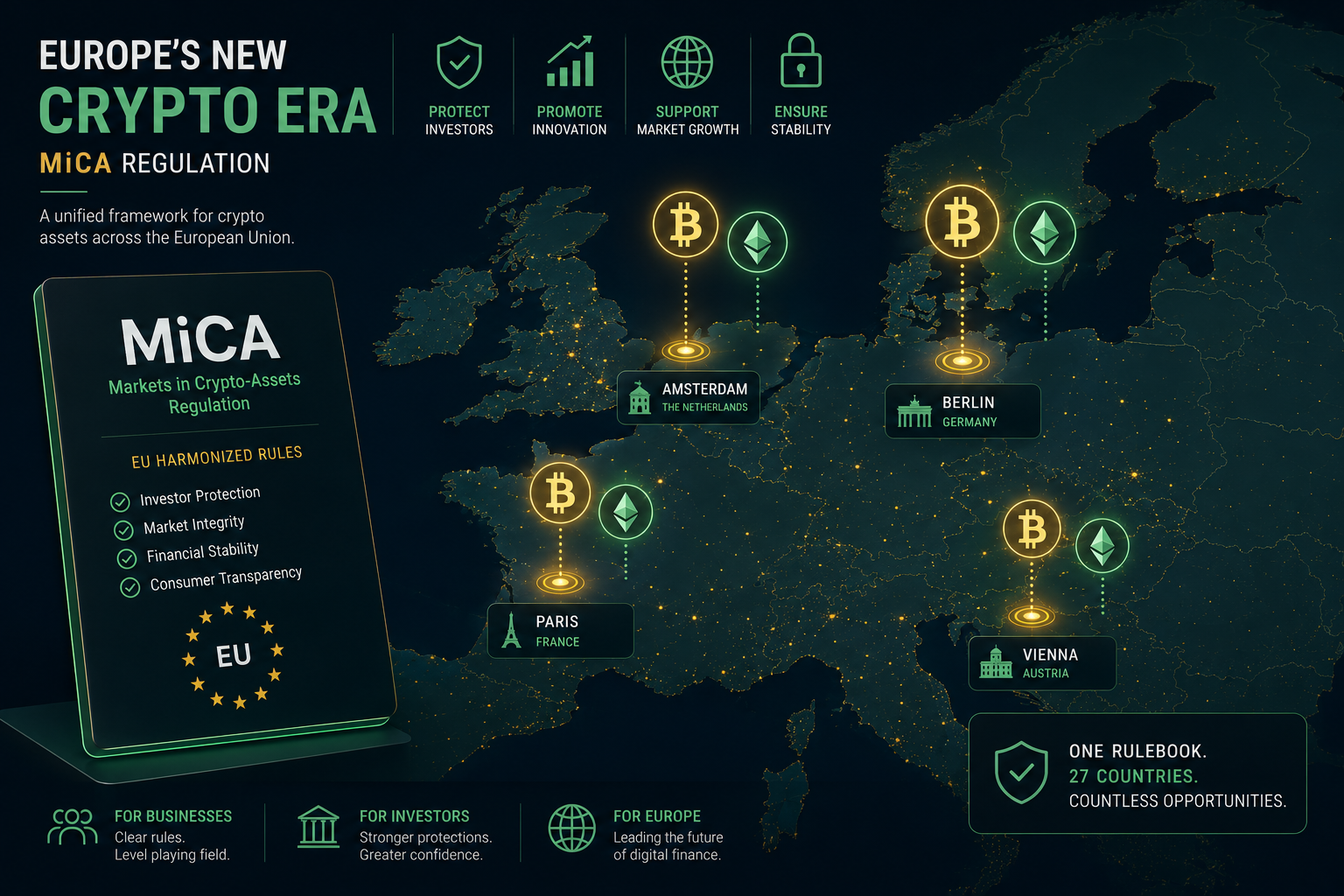
The EU just did something no major economic bloc had done before: it built a single, unified legal
framework for crypto that applies to all 27 member states simultaneously. No more fragmented national
rules. No more regulatory shopping. The era of the Wild West in European crypto is officially over — and
honestly, for long-term investors, that’s a good thing.
The Foundation: MiCA (Markets in Crypto-Assets Regulation)
MiCA is the cornerstone of EU crypto regulation. It entered into force in June 2023 and has been rolling out
in phases ever since. Think of it as the EU’s version of a financial services rulebook — but built specifically
for crypto from the ground up.
Date | What Happened |
June 2023 | MiCA entered into force |
June 30, 2024 | Stablecoin rules (ARTs & EMTs) came into effect |
Dec 30, 2024 | Full MiCA framework for exchanges & service providers applied |
Jan 1, 2026 | DAC8 directive went live — automatic tax reporting begins |
July 1, 2026 | Transitional period ends — full MiCA compliance mandatory for all |
Who Does MiCA Apply To?
MiCA covers all Crypto-Asset Service Providers (CASPs) — that’s exchanges, custodian wallet providers,
trading platforms, and advisors offering crypto-related services in or to EU customers. Every CASP must
obtain authorisation from a National Competent Authority (NCA) in one EU country and can then ‘passport’
their licence across all 27 member states plus Iceland, Liechtenstein, and Norway. One licence, 450+
million potential customers.
What MiCA Requires From Exchanges
- Transparency — clear disclosure of fees, risks, and how the platform works
- Asset segregation — your funds must be kept separate from the company’s funds
- Proof of reserves — platforms must demonstrate they hold all customer assets 1:1
- Consumer protection — formal complaint procedures and 14-day withdrawal rights for new purchases
- Market abuse rules — insider trading and market manipulation are now explicitly illegal
- Capital requirements — exchanges must hold sufficient capital buffers
The Big 2026 Addition: DAC8 (Tax Transparency)
From 1 January 2026, all EU-based crypto exchanges are required to automatically report every user’s
transaction data — buys, sells, transfers, and portfolio values — directly to national tax authorities. This
data is then shared internationally between EU member states. Germany’s Finanzamt, France’s DGFiP,
and every other EU tax office now receive your crypto records directly from platforms like Coinbase and
Kraken. The era of hoping nobody notices is over.
Beyond MiCA: Other Rules Investors Should Know
Transfer of Funds Regulation (TFR)
In force since Dec 2024. Crypto transactions above certain thresholds require both sender and recipient
identity information — similar to bank wire rules.
DORA (Digital Operational Resilience Act)
Applies from January 2025. Forces exchanges to meet bank-level cybersecurity standards and maintain
operational resilience plans.
AMLA (Anti-Money Laundering Authority)
Launching in 2026. Will directly supervise the largest cross-border crypto firms for AML and
counter-terrorism financing compliance.
What MiCA Does NOT Cover
- NFTs (unless fractionalized or marketed as fungible assets)
- Fully decentralized DeFi protocols with no central entity
- Bitcoin and Ethereum as protocols themselves (only services dealing with them are regulated)
- Tokenized traditional financial instruments (covered under MiFID II instead)
What This Means for Investors
If you’re a retail investor in the EU, MiCA is genuinely good news. If an exchange fails, you now have legal
protections. All your fees must be disclosed upfront. The platform must prove it holds your assets. And
market manipulation — the kind that once pumped and dumped small coins — is now explicitly illegal.
The tradeoff? Anonymity is gone. Every trade is tracked. Every gain is taxable and reported. But for
anyone treating crypto as a serious long-term investment — not a way to dodge tax — the regulated EU
market in 2026 is actually one of the most trustworthy in the world.
Penalty for non-compliance:
Exchanges operating without a MiCA CASP licence after 1 July 2026
face fines of up to €15 million or 12.5% of annual turnover — whichever is higher — plus potential
licence revocation and bans for executives.
Pro Tip:
Always check ESMA’s public register before using any European crypto exchange. The
register is updated weekly and lists every authorised CASP. If a platform isn’t on the list and claims to
serve EU customers after July 2026, walk away.
Disclaimer: This content is for educational purposes only and does not constitute financial, legal, or tax advice. Crypto tax laws vary by country and change frequently. Always consult a qualified tax professional or legal advisor for your specific situation. Cryptocurrency is highly volatile — only invest what you can afford to lose.
Pingback: Bitcoin Regulation 2026 — Clarity Act Passes | Crypto Log
Pingback: Best Crypto Trading Apps 2026 — Global Comparison Guide