Here’s the full story — and everything you actually need to know about Germany crypto tax in 2026 before the Finanzamt comes knocking.
■ LEGAL DISCLAIMER
This article is based on personal experience and publicly available information about German tax law as
of May 2026. It is not legal or financial advice. German crypto tax rules change frequently. Always consult
a qualified Steuerberater (tax advisor) specialising in cryptocurrency before making decisions about your
holdings or filing your tax return.
My €47,000 Mistake — and Why It Happened
It was a Tuesday afternoon in Frankfurt. I remember the light coming through the window at an odd angle, the kind that makes you squint when you’d rather be anywhere else. The accountant’s desk was immaculate. My records were not.
I sat there explaining my crypto positions — Bitcoin I’d bought in 2019, a handful of Ethereum
trades from 2020, staking rewards I’d received and, honestly, mostly forgotten about. He kept
nodding. Kept saying ‘ja, ja.’ I thought that was a good sign.
It was not. He was just being German-accountant polite. His pen kept moving, and the number at the bottom of his notepad kept climbing.
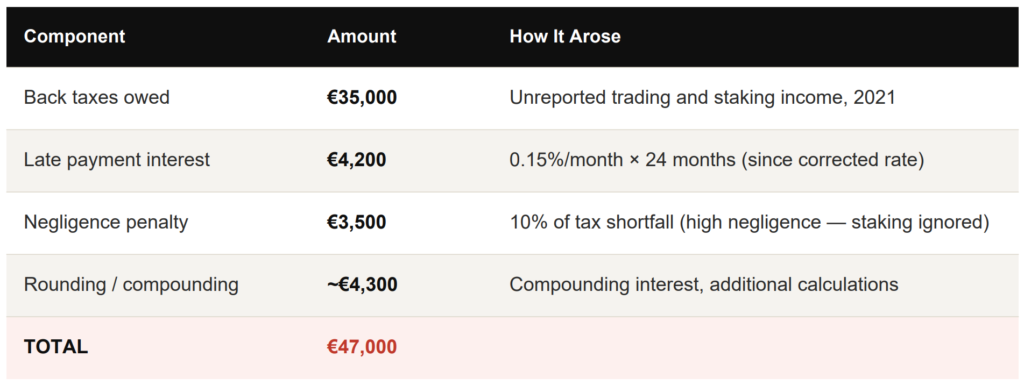
€47,000. Back taxes, interest and penalties. For activity I’d done three years earlier and assumed was either fine or irrelevant.
I wasn’t trying to dodge anything. I genuinely didn’t understand how German crypto tax worked. I’d read in some Discord server that Germany was ‘crypto-friendly.’ Someone said something about a one-year rule. I took that to mean if I held for a year, I was in the clear, full stop. I was wrong — but not in the way you’d expect.
“Ignorance, in the German tax system, is not a defense. It is just more expensive.”
The part that genuinely surprised me wasn’t the tax itself — it was how comprehensively the
Finanzamt already knew about my activity. They had data from exchanges. They had blockchain
records. They weren’t guessing. They were just waiting for me to file correctly, and when I didn’t,
they came to me.
German crypto audits jumped 340% between 2022 and 2024. The Finanzamt has exchange
partnerships, on-chain analytics tools, and the legal authority to go back ten years. If you’ve been
treating crypto tax as optional, this article is for you.
2. How Germany Crypto Tax System Actually Works
Most people hear ‘Germany crypto tax’ and think there’s one rule that covers everything. There
isn’t. Germany categorises crypto income into distinct buckets, and each one is taxed differently.
Getting the bucket wrong is exactly how people end up in a Frankfurt office having a bad Tuesday.
The Three Tax Categories
1 — Sonstige Einkünfte / Spekulationsgewinne (Speculative Gains)
This is where most crypto activity lands. Under §23 EStG (Einkommensteuergesetz), private sales
of assets — including cryptocurrency — within a one-year holding period are taxed as ‘other
income’ (sonstige Einkünfte) at your personal income tax rate. This is your marginal rate, which can
go up to 45% for high earners.
Every trade, every sell, every token swap is a separate taxable event in this bucket. Most retail
traders live here without realising it.
2 — Long-Term Capital Gains (Over One Year)
If you hold cryptocurrency for more than one year and then sell, that gain is completely tax-free
under §23 Abs. 1 Nr. 2 EStG. No cap on the amount. No special threshold. Zero tax, regardless of
whether you made €1,000 or €1,000,000.
✓ KEY FACT — TAX-FREE AFTER ONE YEAR
Cryptocurrency held for more than 12 months and then sold is 100% tax-free in Germany with no upper
limit on gains. This applies to Bitcoin, Ethereum and most other cryptocurrencies held as private assets.
This is confirmed under §23 Abs. 1 Nr. 2 EStG and has been the law since the Bundesfinanzministerium
first clarified crypto’s treatment.
3 — Einkünfte aus Gewerbebetrieb (Business Income)
If the Finanzamt decides you’re running a crypto trading business rather than simply investing, your
income shifts into the business category. This means trade tax (Gewerbesteuer) applies, you may
need to register a business, and losses carry forward differently. The threshold isn’t perfectly
defined in law, but making 10 or more trades per month will draw scrutiny.
How the Finanzamt Decides: Trader vs. Investor
This distinction matters more than people realise. The Finanzamt looks at frequency, volume, and
stated intention. There’s no hard rule — it’s assessed case by case. But as a rough guide: a few
trades per month with a long-term view keeps you in the investor category. Daily or high-frequency
trading for income pushes you toward the business category, with all the complexity that brings.
3. The One-Year Holding Period Rule — Corrected and
Explained
This is the rule that, understood correctly, makes Germany genuinely one of the better places in
Europe for long-term crypto investors. But it’s also the rule that causes the most confusion —
because it’s regularly misquoted online.
■ CORRECTING A COMMON MYTH
Many articles, forums and even some advisors claim that Germany’s tax-free crypto rule only applies if
your gains are below €600. This is wrong. The €600 Freigrenze (explained in the next section) applies to
SHORT-TERM gains — crypto held for less than one year. Long-term gains (held over one year) are
completely tax-free with NO limit on the amount. These are two entirely separate rules.
The Core Rule, Stated Clearly
Under §23 EStG: if you buy cryptocurrency and sell it after holding for more than 12 months, the
entire gain is exempt from tax. That’s it. No forms to file for that gain, no threshold to stay under, no
special application required. The clock starts on the day of purchase and ends on the day of sale.
What Resets the Clock
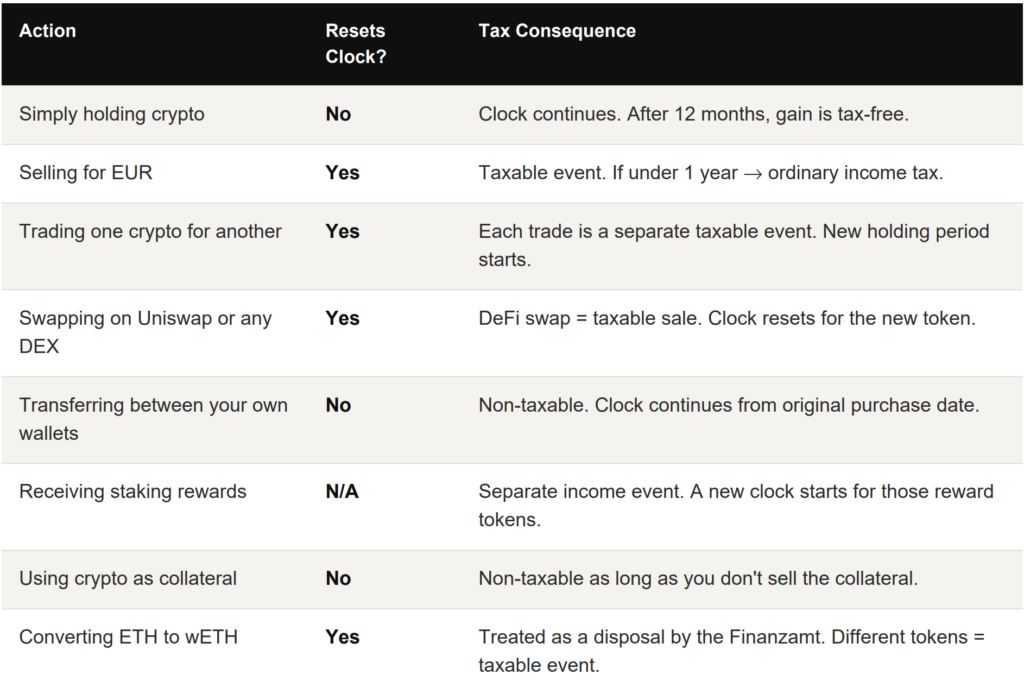
The practical trap here is that the average German crypto trader — according to BaFin data —
makes around 4.3 trades per month. Every trade resets the clock for that portion of their holdings.
Most people are therefore stuck in the short-term speculative income bracket at their full marginal
rate, even if they thought of themselves as ‘investors.”
The one-year rule rewards patience and penalises impatience. If you can actually hold without
touching your position, Germany becomes one of the most tax-efficient jurisdictions in Europe for
crypto. If you trade frequently, it becomes one of the most expensive.
4. The €600 Freigrenze — What It Actually Means
This exemption gets misunderstood almost every time it’s mentioned. Let’s clear it up once and for
all.
Under §23 Abs. 3 Satz 5 EStG, there is an annual Freigrenze of €600 for private sale gains —
meaning gains from assets held less than one year. If your total short-term gains for the year are
below €600, you pay no tax on them at all.
■ FREIGRENZE VS. FREIBETRAG — AN IMPORTANT DISTINCTION
A Freigrenze is a threshold, not an allowance. If your short-term gains are €599, you pay zero tax. If they
are €601, you pay tax on the full €601 — not just the €1 above the threshold. This trips people up. The
€600 is not a deductible amount; it is a cliff edge. Cross it, and the whole amount becomes taxable.
What the €600 Freigrenze Does NOT Cover
The exemption only applies to speculative gains from assets held under one year. It does not apply
to staking income, mining income, DeFi yield, or any other form of crypto earnings. Those are
taxed as ordinary income from the first euro. This is a separate tax bucket entirely.
And to repeat: long-term gains (held over one year) don’t need the Freigrenze at all. They’re
already fully tax-free. The two rules operate independently.
5. German Staking Tax: The 2024 Ruling That Changed
Everything
For years, there was genuine ambiguity in Germany about how staking rewards should be treated.
Were they capital gains? Were they income? Could you argue they didn’t exist until you sold them?
In early 2024, the Bundesfinanzministerium settled the question definitively.
The Ruling: Taxable on Receipt, at Market Value
Staking rewards are treated as ordinary income (sonstige Einkünfte) in Germany. They become
taxable the moment they hit your wallet, valued in EUR at the market rate on that specific day. Not
when you sell them. Not when the market recovers. The day you receive them.
This has brutal implications for anyone staking through a bear market. Here’s the scenario that
broke a lot of strategies:
The Staking Tax Trap — A Real ScenarioTitle
January 2023: You stake 10 ETH (total value €20,000). Throughout 2023: You earn 0.5 ETH in staking
rewards. Average price during receipt: €2,500/ETH. Taxable income recognised: €1,250. April 2024: ETH
crashes to €1,500. Your 0.5 ETH reward is now worth €750. The problem: You owe income tax on €1,250
of ‘income’ that is now worth only €750. And you cannot offset staking income losses against trading
losses — they are in different tax buckets. If you sell the rewards to cover your tax bill, you may realise a
further capital loss — which also cannot offset the income tax already owed.
What the Finanzamt Needs for Staking Records
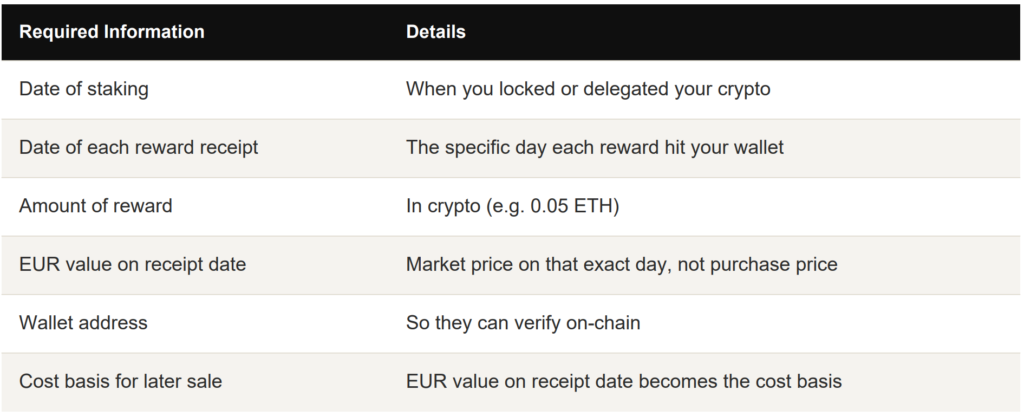
Most exchanges don’t format staking data in a way that satisfies the Finanzamt. Staking pools
rarely do either. This is where crypto tax software —
, Accointing, or CoinTracker —
becomes genuinely essential rather than just convenient. These tools pull your reward history and
calculate the EUR value on each receipt date automatically. (See our guide to the best crypto tax
software for Germany [internal link: /best-crypto-tax-software/] for a full comparison.)
6. Crypto Trading, Mining and DeFi — How Germany
Taxes Each
Trading
Every trade is a taxable event, whether it happens on a centralised exchange or a DEX. The key
variable is holding period. Under one year: you pay income tax at your marginal rate. Over one
year: tax-free.
Crypto-to-crypto trades are taxed the same as crypto-to-EUR trades. If you swap ETH for USDT on
Binance and both have been held for less than a year, you’ve realised a taxable gain or loss at that
moment. The fact that you never touched euros is irrelevant to the Finanzamt
FIFO (first in, first out) is the standard cost basis method used in Germany. This means the first
coins you bought are treated as the first ones sold. Some tax software allows other methods —
check with your Steuerberater about what the Finanzamt will accept for your specific situation.
Mining
Mining income is treated as ordinary income taxable on the day you receive the mined coins, at the
EUR value on that day. If you mine 0.05 BTC when Bitcoin is trading at €60,000, that’s €3,000 in
taxable income for that year.
The cost basis for mined coins is the EUR value at the time you received them. If you later sell
those coins, only the appreciation above that cost basis is taxable as a gain — and the one-year
rule applies from the day you mined them.
DeFi — The Area Most People Get Wrong
DeFi taxation in Germany is comprehensive and sometimes harsh. The Finanzamt has been clear:
DeFi is not a grey area. Here is how common DeFi interactions are treated:
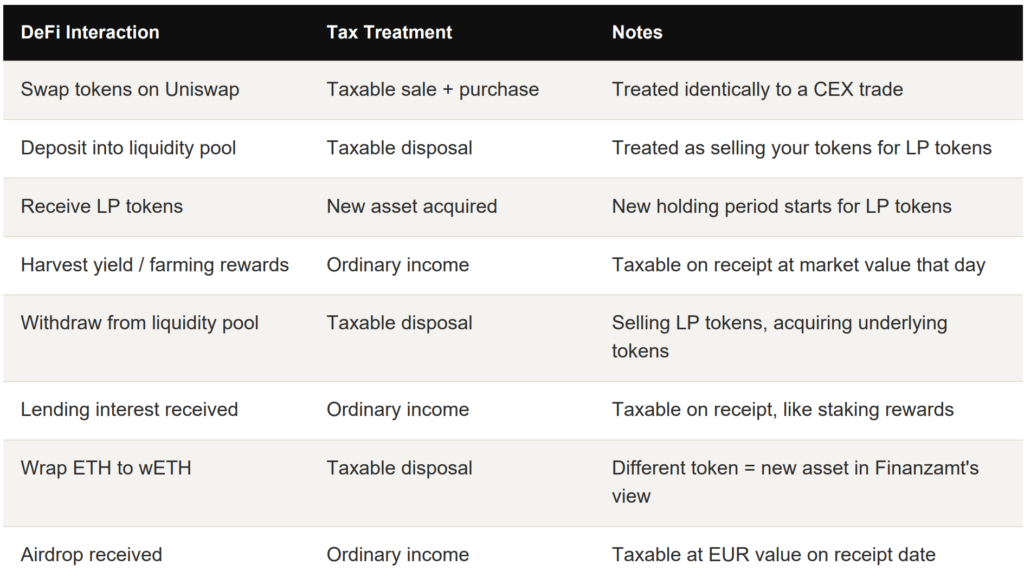
The Finanzamt can and does trace DeFi transactions on-chain. You cannot hide activity by using a
DEX instead of a centralised exchange. If anything, on-chain activity is more transparent to
auditors because the blockchain is a permanent public record.
7. Record-Keeping: Your Biggest Risk Isn’t the Tax Rate
I used to think my problem was the tax rate. It wasn’t. My problem was that I couldn’t prove
anything. When the Finanzamt came, I had no documentation, no transaction logs, no exchange
statements — nothing organised. And without documentation, they switched to Schätzung:
estimation.
“The Finanzamt doesn’t want your best guess. It doesn’t want a
spreadsheet you built from memory. It wants precision that borders
on obsessive.”
What Schätzung (Estimation) Means for You
When you can’t produce records, the Finanzamt estimates your tax liability based on available data
— and they estimate against you. They looked at my Kraken deposits of €30,000 and assumed I’d
turned all of it into €47,000 in profit. Without documentation, I had no way to prove otherwise.
What to Keep — The Finanzamt’s Checklist
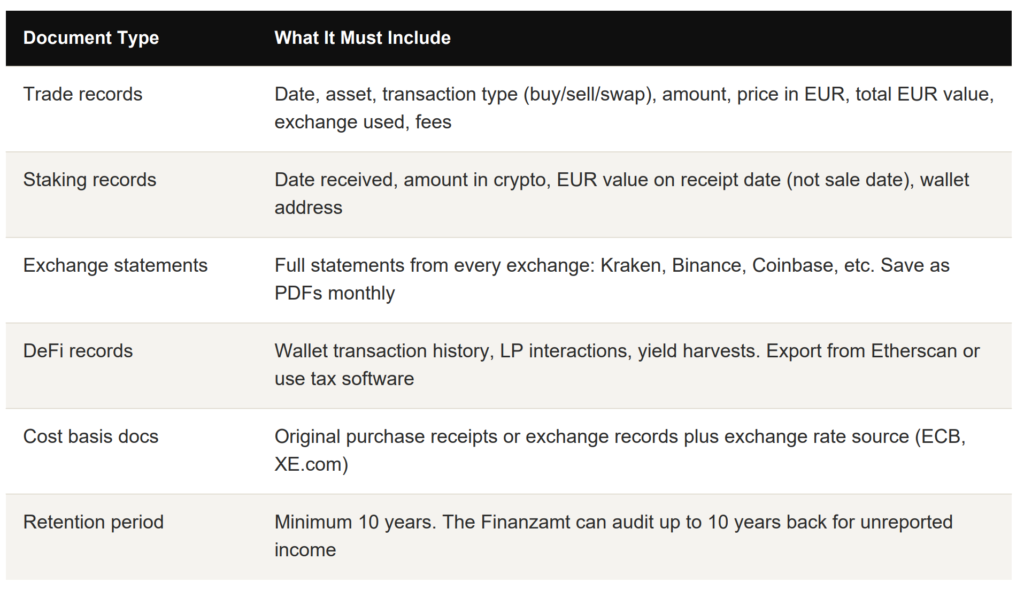
→ RECOMMENDED TOOLS
Koinly (koinly.io) — Automatic exchange imports, German tax report export. Supports DeFi and NFT activity.Accointing — Built specifically with German tax rules in mind. Handles staking reward valuation.
CoinTracker — Strong DeFi tracking, good for complex multi-chain portfolios. These tools cost €100–500
per year and generate formatted reports your Steuerberater can use directly.
8. The Finanzamt Audit Process — Step by Step
Getting audited for crypto in Germany follows a fairly predictable process. Here’s what actually
happens, based on direct experience.
Stage 1: The Letter
Aufforderung zur Abgabe einer Steuererklärung. A certified letter arrives requesting documentation
for your crypto holdings and transactions for the year in question. You have 30 days to respond.
You can request an extension — usually granted if you ask promptly and have a Steuerberater. Do
not ignore this letter.
Stage 2: Documentation Submission
You submit your records. If they’re comprehensive and credible, the Finanzamt may issue a
straightforward adjustment with minimal additional scrutiny. If documentation is incomplete or
missing, they move to estimation (Schätzung) mode. This is where having a crypto tax specialist
makes an immediate, measurable difference.
Stage 3: Assessment (Veranlagung)
The Finanzamt issues their calculation of your tax liability. You have one month to accept it or
appeal. Most people accept out of exhaustion. That’s often the wrong move — even a partially
correct assessment can be worth appealing, and a Steuerberater can identify errors.
Stage 4: Payment
Back taxes, interest and penalties become due. Payment plans (up to 60 months) are available if
you can’t pay in one go, but require a formal application. Interest continues to accrue during any
payment plan.
Can You Negotiate With the Finanzamt?
Yes, but almost only with professional help. A Steuerberater who specialises in crypto can argue
for reduced penalties (from 10% to 5% or lower), interest waivers in cases of genuine hardship,
and manageable payment plans. Without representation, you’re unlikely to get meaningful
concessions.
9. BaFin’s 2023 Crackdown and What Changed
BaFin — Germany’s financial regulator — doesn’t set tax policy, but their decisions have direct
consequences for how crypto is taxed and monitored. In 2023, they came down hard on crypto
exchanges operating in Germany.
Kraken pulled out of German derivatives trading. Binance began enforcing stricter KYC
requirements and tightened withdrawal limits for German accounts. Coinbase scaled back services
due to regulatory uncertainty. None of this made crypto illegal — it made crypto traceable.
BaFin regulations now require exchanges operating in Germany to maintain transaction records
and provide them to the Finanzamt on request. Your trades are not hidden. They’re documented,
timestamped, and accessible to tax authorities through formal data-sharing agreements.
If you didn’t report trades on Kraken or Binance between 2020 and 2024, the Finanzamt may
already have the data. They’re just waiting for your return to cross-reference it.
10. German Crypto Tax Rates by Income Type (2026)
Income Tax Brackets (Spekulationsgewinne / Staking / Mining / DeFi)
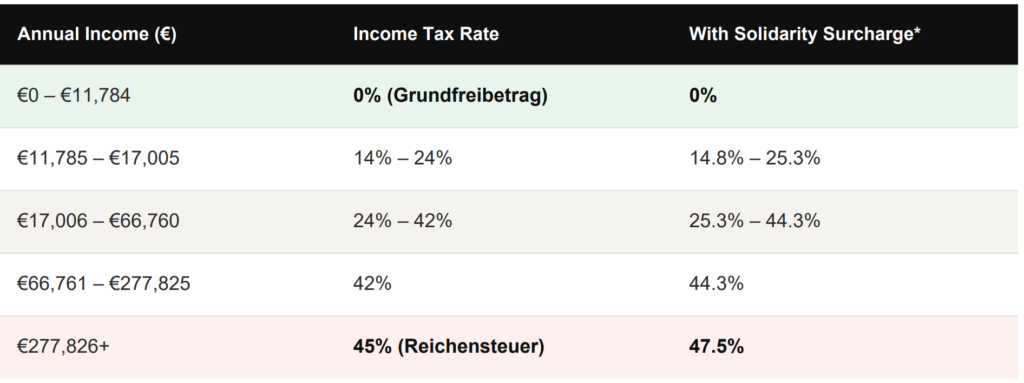
- The Solidarity Surcharge (Solidaritätszuschlag) was largely abolished from 2021 for the vast
majority of taxpayers. As of 2026, it only applies to individuals with a tax liability above the
exemption threshold (roughly €96,820 annual income for singles). If you’re a high earner paying
the top rate, add 5.5% on top of your income tax rate. If you’re a normal earner, you likely pay zero
Soli.
■ CHURCH TAX (KIRCHENSTEUER) — ONLY IF APPLICABLE
Church tax (8–9% of your income tax, depending on your German state) only applies if you are registered
as a member of a recognised church in Germany. It is not universal. If you have left the church
(Kirchenaustritt) or were never registered, you do not pay this. Factoring it into every calculation, as many
articles do, is misleading
Capital Gains (Over One Year) — Rate Summary
✓ LONG-TERM GAINS: COMPLETELY TAX-FREE
Cryptocurrency held for more than 12 months: 0% tax regardless of gain size. No Soli. No church tax. No
income tax. This is confirmed under §23 Abs. 1 Nr. 2 EStG and applies to private investors. This is the
single most important rule in German crypto taxation.
11. Penalties, Interest and Back Taxes — The Real
Numbers
Late Payment Interest
A correction from many older articles: Germany’s late payment interest rate for taxes was changed
by the Bundesverfassungsgericht (Federal Constitutional Court) in 2021, which ruled the old 0.5%
per month rate unconstitutional. Since 2022, the rate is 0.15% per month (1.8% per year). It still
compounds, but it’s no longer as extreme as older sources suggest.
Negligence Penalties
If you failed to report through carelessness rather than deliberate intent, the standard negligence
penalty (Fahrlässigkeit) is 5% of the tax shortfall. In cases of high negligence — where you
received income and made no effort to track or report it — this can climb to 10%.
Tax Evasion (Steuerhinterziehung)
Intentional evasion carries penalties of 50–100% of the tax shortfall and can result in criminal
prosecution. The distinction between negligence and evasion often comes down to whether you
received professional tax advice and ignored it. Most audit cases for crypto land in the negligence
category.
What My €47,000 Bill Actually Broke Down To
12. How to Calculate Your German Crypto Taxes —
Worked Example
Let’s walk through a realistic 2024 tax year to show exactly how this works in practice. This uses
the corrected rules — not the common misunderstanding.
Scenario: Your 2024 Activity
- January: Buy 1 BTC for €50,000
- March: Stake 10 ETH (total value €30,000). Non-taxable event.
- May: Receive 0.3 ETH staking rewards when ETH is at €3,000. Value: €900.
- September: Sell 1 BTC for €65,000. Held 8 months (under 1 year).
- December: Sell 2 ETH from your original stake. Original cost: €6,000. Sale price: €8,000. Held 9+
months (under 1 year).
Step 1: Categories Each Transaction
| Transaction | Category | Holding Period |
|---|---|---|
| Buy 1 BTC | N/A (acquisition) | — |
| Stake 10 ETH | Non-taxable | Clock continues from purchase date |
| Receive 0.3 ETH reward | Ordinary income | Taxable on receipt. New holding period starts for reward ETH. |
| Sell 1 BTC | Speculative gain (§23 EStG) | 8 months — under 1 year → taxable |
| Sell 2 ETH | Speculative gain (§23 EStG) | 9+ months — under 1 year → taxable |
Step 2: Calculate Each Gain
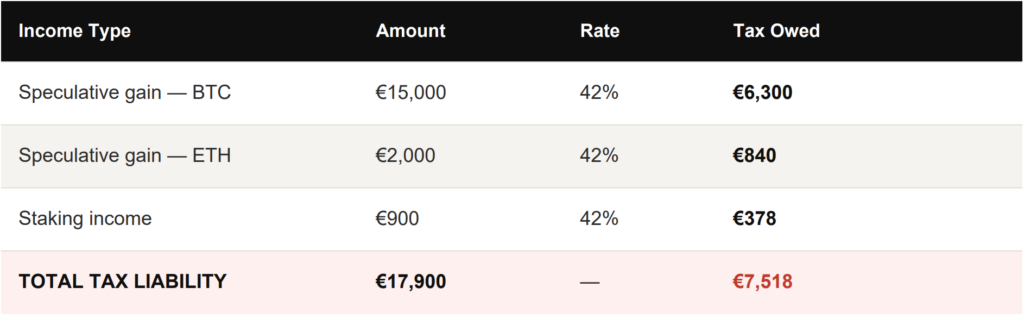
BTC trade: Sell €65,000 − Buy €50,000 = €15,000 gain. Held under 1 year → speculative income.
Staking reward: 0.3 ETH × €3,000 = €900 ordinary income. Recognised in May when received.
ETH sale: Sell €8,000 − Buy €6,000 = €2,000 gain. Held under 1 year → speculative income.
Step 3: Apply the €600 Freigrenze
Total short-term speculative gains: €15,000 + €2,000 = €17,000. This exceeds €600, so the
Freigrenze does not apply. The full €17,000 is taxable.
Step 4: Calculate Tax (assuming 42% marginal rate, no Soli, no church tax)
→ HOW DIFFERENT WOULD IT HAVE BEEN?
If you had held the BTC for 4 more months (total 12+ months): €15,000 gain = €0 tax. The ETH held
another 3 months: €2,000 gain = €0 tax. Total tax saved: €7,140. The one-year rule is not a minor
technicality. It is the foundation of any tax-efficient crypto strategy in Germany. See our crypto tax
calculator [internal link: /crypto-tax-calculator/] to run your own numbers.
13. Finding a Crypto Tax Advisor in Germany
(Steuerberater)
If you’ve done anything beyond simply buying and holding — if you’ve staked, traded, used DeFi,
or moved coins between wallets — you need a Steuerberater who understands crypto. A regular
accountant will not be enough.
Why Most Regular Accountants Fail at Crypto
A standard German Steuerberater understands employee income, business income, real estate
and dividends. Give them a wallet export file, a Uniswap transaction history, or a list of staking
rewards, and most of them will either estimate conservatively (which means high taxes) or refuse
to engage with it at all.
What to Look for in a Crypto Steuerberater
- Crypto specialisation listed on their website
If it’s not on the front page, ask explicitly whether they handle DeFi and on-chain transactions.
- Experience defending audits, not just filing returns
Filing is the easy part. If you get audited, you need someone who knows how the Finanzamt
processes crypto cases.
- Proficiency with tax software
They should actively use Koinly, Accointing, or a similar tool. If they want you to manually transfer
everything into a spreadsheet, find someone else.
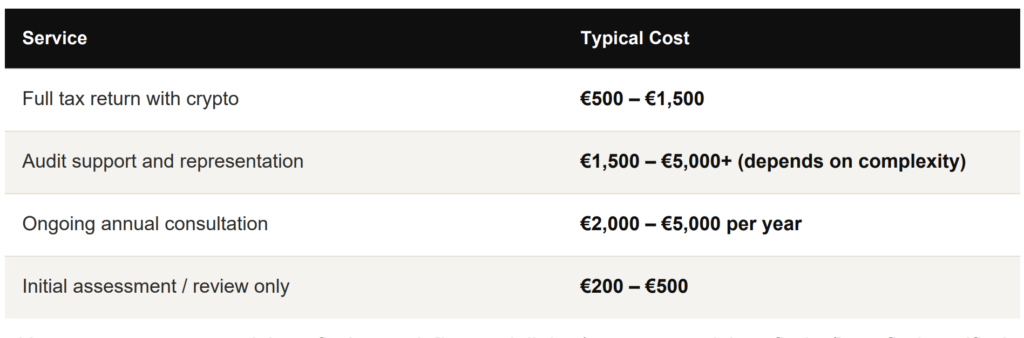
- Flat fee pricing
Flat fees of €500–800 for a full crypto return review are common and appropriate. Be wary of
hourly rates with no estimate — crypto cases can get complex quickly.
- DeFi and NFT experience
These are the areas most advisors struggle with. Ask specifically about their experience with
liquidity pools and yield farming.
Expected Costs
14. FAQ — Everything Else You’re Wondering About
Q. Do I have to report small amounts of crypto in Germany?
A. Yes. There is no minimum reporting threshold. All crypto holdings and transactions must be
declared. However, if your total short-term gains for the year are below €600 (the Freigrenze), no
tax is actually owed on those short-term gains. Report everything, pay based on what’s taxable.
Q. Is crypto completely tax-free in Germany after one year?
Yes, for private investors. Gains from cryptocurrency held for more than 12 months are 100%
tax-free under §23 Abs. 1 Nr. 2 EStG, with no upper limit on the gain amount. This is one of the
most generous long-term crypto tax rules in Europe. The exemption does not apply to staking
rewards, mining income, or DeFi yields.
Can the Finanzamt access my exchange data without my consent?
Yes. BaFin regulations require exchanges operating in Germany to share transaction data with the
Finanzamt on request. This includes Kraken, Binance, Coinbase and others. Your trades on these
platforms are not private from the tax authority.
Can I deduct crypto trading losses in Germany?
Yes, within the same tax category. Short-term trading losses can offset short-term trading gains in
the same year, and carry forward to future years. Losses from trading cannot offset staking income
or mining income — those are separate tax buckets. There is no time limit on carrying forward
speculative losses.
Is DeFi taxable in Germany?
Yes, comprehensively. Every DeFi interaction — swaps, liquidity pool deposits, yield harvests,
withdrawals — is a taxable event. The Finanzamt has stated clearly that DeFi is not a grey area. All
on-chain transactions are traceable.
What if I got airdropped tokens in Germany?
Airdropped tokens are taxed as ordinary income on the day you receive them, at the EUR value on
that date. The cost basis for future sales is that receipt-date value.
What if I lost access to my crypto through a hack or lost keys?
You can claim a loss, but you need to document it: original cost, the date you determined the loss
was permanent, and evidence that you no longer have access. The loss is deductible only in the
year you determined it was unrecoverable. You cannot retroactively claim losses in prior years.
How do I report crypto if I’m self-employed in Germany?
Self-employed individuals report crypto activity on Anlage S (self-employment income) or Anlage
EÜR if you use simplified accounting. If trading is your primary income activity, you may need to
register a business (Gewerbe) and pay trade tax.
What’s the penalty for not reporting crypto in Germany?
The Finanzamt can go back 10 years for unreported income. Penalties include late payment
interest at 1.8% per year, negligence penalties of 5–10% of the tax shortfall, and evasion penalties
of 50–100% (plus possible criminal prosecution) for deliberate concealment.
Are there any legitimate tax breaks for crypto in Germany?
Yes: the one-year tax-free holding period (the most powerful), the €600 Freigrenze for short-term
gains, indefinite carryforward of speculative losses, and business expense deductions if you’re
operating as a crypto business. These are the main ones.
How does FIFO work for crypto in Germany?
FIFO (First In, First Out) means the coins you bought first are treated as the first ones sold. This
matters for calculating your holding period and cost basis, particularly when you’ve made multiple
purchases of the same asset at different prices. Consistent method application across your return
is important.
What if my partner or spouse has unreported crypto?
Each person files individually. You are not automatically liable for your partner’s tax. However, if
you filed joint returns (Zusammenveranlagung) and their income was omitted, there could be joint
liability for penalties. Consult a Steuerberater for your specific situation.
DISCLAIMER
This article is based on personal experience and publicly available information about German tax law as of May 2026. It is
not legal or financial advice. German crypto tax rules change frequently — the Bundesfinanzministerium issues new
guidance, the Bundesfinanzhof makes new rulings, and BaFin updates its regulatory requirements on an ongoing basis.
The rules described here are accurate to the best of our knowledge as of the publication date, but must be verified with a
qualified professional before you make any decisions about your crypto holdings, trades or tax filing. Always consult a
Steuerberater who specialises in cryptocurrency. Do not rely solely on any online article, including this one.
Sources: §23 EStG (gesetze-im-internet.de) | Bundesministerium der Finanzen (BMF-Schreiben, 2022) | Bundesfinanzhof
rulings on cryptocurrency | BaFin crypto exchange guidance (2023–2024) | Bundesverfassungsgericht ruling on interest
rates (2021) | Koinly German tax guide | Accointing Germany guide.